Publications
Featured publications
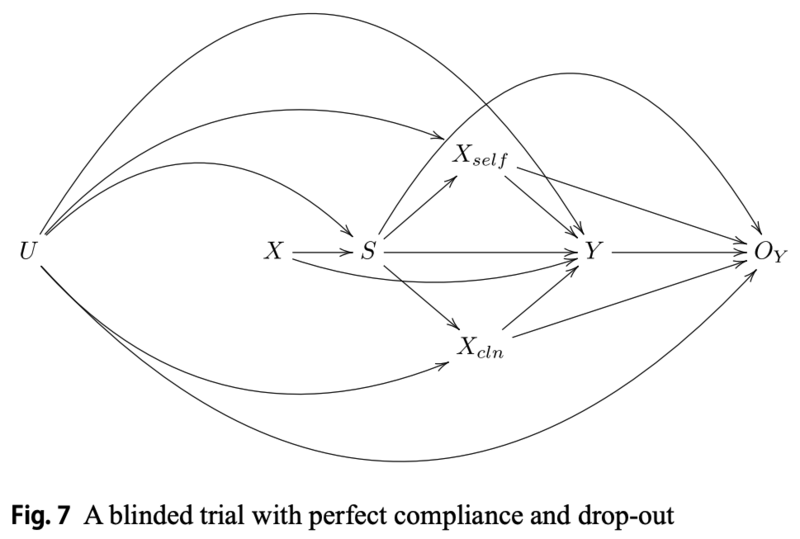
Gabriel, E.E., Ocampo, A. & Sjölander, A. Elucidating some common biases in randomized controlled trials using directed acyclic graphs. Eur J Epidemiol (2025). https://doi.org/10.1007/s10654-025-01298-7
Author's summary: "Although the ideal randomized clinical trial is the gold standard for causal inference, real randomized trials often suffer from imperfections that may hamper causal effect estimation. Stating the estimand of interest can help reduce confusion about what is being estimated, but it is often difficult to determine what is and is not identifiable given a trial's specific imperfections in advance. We demonstrate how directed acyclic graphs can be used to elucidate the consequences of common imperfections, such as noncompliance, unblinding, and drop-out."
Wray, N.R., Lin, T., Li, A., de Almeida, V., Ziller, M. & Zeng, J. Progress in understanding the biological basis of polygenic disorders. Current Opinion in Genetics & Development 2026 https://doi.org/10.1016/j.gde.2025.102433
Author summary:
- Focuses on an overlooked supplement from their 2020 paper, which used simulations to provide insight on how interacting evolutionary parameters generate genetic architecture parameters that are estimable from GWAS data.
- Highlights the empirical observation that psychiatric disorders are much more polygenic than other diseases, and considers why this knowledge is important in planning research relevant to adult-onset psychiatric disease
- Highlights that given the high polygenicity of psychiatric disorders, data integration of genetic risk with omics reference data sets is an important strategy to take forward understanding of causal pathways - these approaches show genetic risk variants are enriched in excitatory/inhibitory neurons particularly glutaminergic neurons.
- Advocates for new reference data sets that generate brain gene expression in model species exposed to known environmental risk factors of psychiatric disorders, which can be further integrated with genetic risk results. It is anticipated that gene expression genes associated with environmental exposures will be further enriched for genetic risk genes identified from human participants.
- Advocates for assays conducted on inhibitory/excitatory neuronal cultures derived from blood cells of people with known clinical histories to be investigated as potential blood biomarkers.
The forward-looking recommendations contribute to the thinking behind some SMARTbiomed research approaches.
The Pioneer Centre
for SMARTbiomed
The Pioneer Centre for Statistical and Computational Methods for Advanced Research to Transform Biomedicine (SMARTbiomed) was established in June 2024 and will run until 2036. It is anchored at Aarhus University with hub sites at the University of Copenhagen and University of Oxford.