SMARTbiomed summer school 2026
About the course
The SMARTbiomed summer school in “Statistical Genetics, Causal Inference, and Multi-omics and Machine Learning” is designed to introduce researchers to modern methods of computational and statistical analysis of complex data. The module content will focus on statistical genetics, causal inference, machine learning based approaches including applications to multi-omics and clinical prediction. Modules will motivate methods developments through theory in lectures, but with clear applications in mind, laid out through extensive, hands-on practicals throughout the week. The summer school is also a fantastic opportunity to broaden your professional network and to engage with the experts that are part of the SMARTbiomed Pioneer Centre, principly split between researchers in the UK and Denmark.
Find out more about the Pioneer Centre for SMARTbiomed here: https://smartbiomed.dk/.
Participants
Any junior researcher from across the globe interested in the theory, development, and real world application of modern methods of computational and statistical analysis to complex datasets.
Courses
The summer school will consist of three courses, outlined below. Click on each course title to read more details about its content:
Statistical genetics
This course will serve as an introduction to the foundational concepts and methods in statistical genetics, providing participants the motivation and theory behind key approaches, as well as practical experience in handling and analysing genetic data.
Topics will include an exploration of the principles of common and rare variant association testing, polygenic risk score estimation, heritability and genetic correlation estimation.
Causal inference
This course will introduce foundational concepts in causality and causal inference, providing participants the background reasoning needed to form estimands and discuss estimators. We will then build on this foundational knowledge, focusing on methodology through example-driven applications to real-world datasets, rather than language or concepts.
Machine Learning with applications to multi-omics and clinical prediction
The first part of the course will provide a general introduction to clinical prediction models. Participants will get an overview of the health AI landscape including different data modalities, and clinically relevant concepts like algorithmic fairness. The second part of the course will focus on multi-omics data modalities; including proteomics, lipidomics and transcriptomics. We will introduce foundational machine learning concepts, including supervised and unsupervised learning, dimensionality reduction, clustering, key learning algorithms. We will explore how machine learning can be applied to such multi-omics and multi-modal data, with an emphasis on advancing our understanding of human diseases and enabling more precise diagnostics, prevention, and treatment strategies.
Guest lectures
Each day will culminate with a guest lecture, delivered by an expert from one of the three courses, to encourage cross-talk between attendees. These lectures will focus on cutting edge applications of methods and principles laid out across the week, to drive discussion.
Timetable
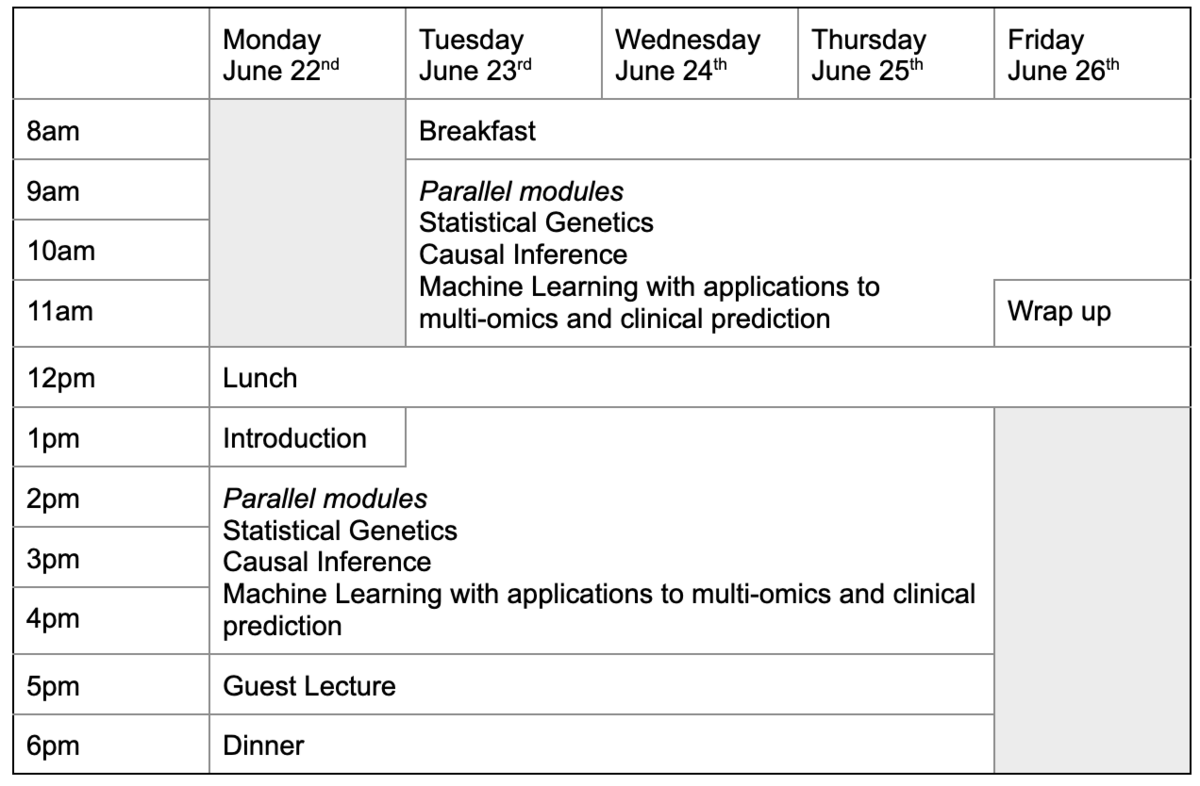
Accommodation and catering
Accommodation and all meals are included in the registration fee (lunch 22 June - lunch 26 June).
How to get there
From Aarhus:
- Train from Aarhus central station to Fredericia train station.
- Train from Fredericia train station to Sønderborg train station.
- Taxi from Sønderborg train station to Sandbjerg Gods.
From Copenhagen:
- Train from Copenhagen central station to Sønderborg train station.
- Taxi from Sønderborg train station to Sandbjerg Gods.
International arrival:
- Fly to Copenhagen airport.
- Flight from Copenhagen airport to Sønderborg airport.
- Taxi from Sønderborg airport to Sandbjerg Gods.
Registration:
If you are currently living within the European union (EU) please register here:
If you are currently living outside of the EU please register here:
Please note: Each course has a limited number of seats. To secure your spot in a specific course, we recommend signing up early.
If your preferred course is fully booked, don’t hesitate to join the waiting list. Not all summer school spots are released for registration right away, so there’s still a chance we can accommodate you.
Time:
22 June 2026, at 12:00 - 18:00
23 June 2026, at 9:00- 18:00
24 June 2026, at 9:00 - 18:00
25 June 2026, at 9:00 - 18:00
26 June 2026, at 9:00 - 13:00
Location:
Sandbjerg Gods
Sandbjergvej 102
DK-6400 Sønderborg
https://www.sandbjerg.dk/en-gb
Registration fee:
DKK 8,000.00 incl. VAT
Accommodation and meals included within registration fee.
Registration deadline:
12 April 2026
Language:
English
Main teachers:
Statistical Genetics
Professor Matthew Robinson, Institute of Science and Technology Austria, Klosterneuburg, Austria.
Dr Duncan Palmer, SMART biomed Senior Research Fellow, Department of Statistics, and the Big Data Institute, University of Oxford, UK.
Causal Inference
Professor Erin Evelyn Gabriel, Department of Public Health, Section of Biostatistics, University of Copenhagen, Denmark.
Professor Michael Sachs, Department of Public Health, Section of Biostatistics, University of Copenhagen, Denmark.
Machine Learning with applications to multi-omics and clinical prediction
Associate Professor Adam Hulman, Department of Public Health, Aarhus University, Denmark.
Professor Christopher Yau, Nuffield Department of Women’s and Reproductive Health, and the Big Data Institute, University of Oxford, UK.
Additional teachers:
Professor Naomi Wray, Department of Psychiatry, and the Big Data Institute, University of Oxford, UK.
Professor Pier Palamara, Department of Statistics, University of Oxford, UK.
Professor Bjarni Jóhann Vilhjálmsson, National Centre for Register-based Research, Aarhus University, Denmark.
Professor Peter Visscher, Nuffield Department of Population Health, and the Big Data Institute, University of Oxford, UK.
Guest lecturers:
Professor Peter Visscher, Nuffield Department of Population Health, and the Big Data Institute, University of Oxford, UK.
Dr Emilie Wigdor, Department of Paediatrics, University of Oxford, UK
Professor Bjarni Jóhann Vilhjálmsson, National Centre for Register-based Research, Aarhus University, Denmark.
Professor Pier Palamara, Department of Statistics, University of Oxford, UK